
National Trust UK
National Trust (UK) — Custom Website Development Case Study
Custom Website Development
Problem
The National Trust, one of the UK’s most respected conservation and heritage organisations, operates a vast digital presence encompassing properties, gardens, historic houses, membership, donation flows, and editorial content. But their site faced several structural and technical challenges:
Legacy infrastructure and rigid architecture
Their platform was not sufficiently flexible or modular to support evolving campaigns, site features, and a large diversity of content types (places, events, stories, donations).
Performance & scalability constraints
The sheer scale of catalog pages (properties, estates, trails), high-resolution media, interactive maps, and membership/donation flows caused performance bottlenecks, particularly on mobile and low-bandwidth connections.Content / Commerce / Membership friction
The merging of editorial storytelling (e.g. Discover & Learn content), membership portals, event bookings, and donation mechanisms lacked seamless UX integration, causing user drop-off during transitions between content and transactional flows (e.g. “Discover a place” → “Become a member / visit”).Campaign agility & experimentation limitations
Running seasonal or promotional campaigns (e.g. “Explore autumn landscapes,” “heritage open days,” “donation drives”) required custom code support, slowing turnaround and limiting flexibility for the marketing team.Complex navigation & personalization challenges
Users exploring different needs (visitors, members, donors, educators) had to navigate through a one-size-fits-all structure, making it hard to deliver tailored experiences or personal recommendations.
These issues collectively hindered the National Trust from fully maximizing the digital experience for visitors, members, and donors — and limited their ability to evolve the platform responsively.
Solution
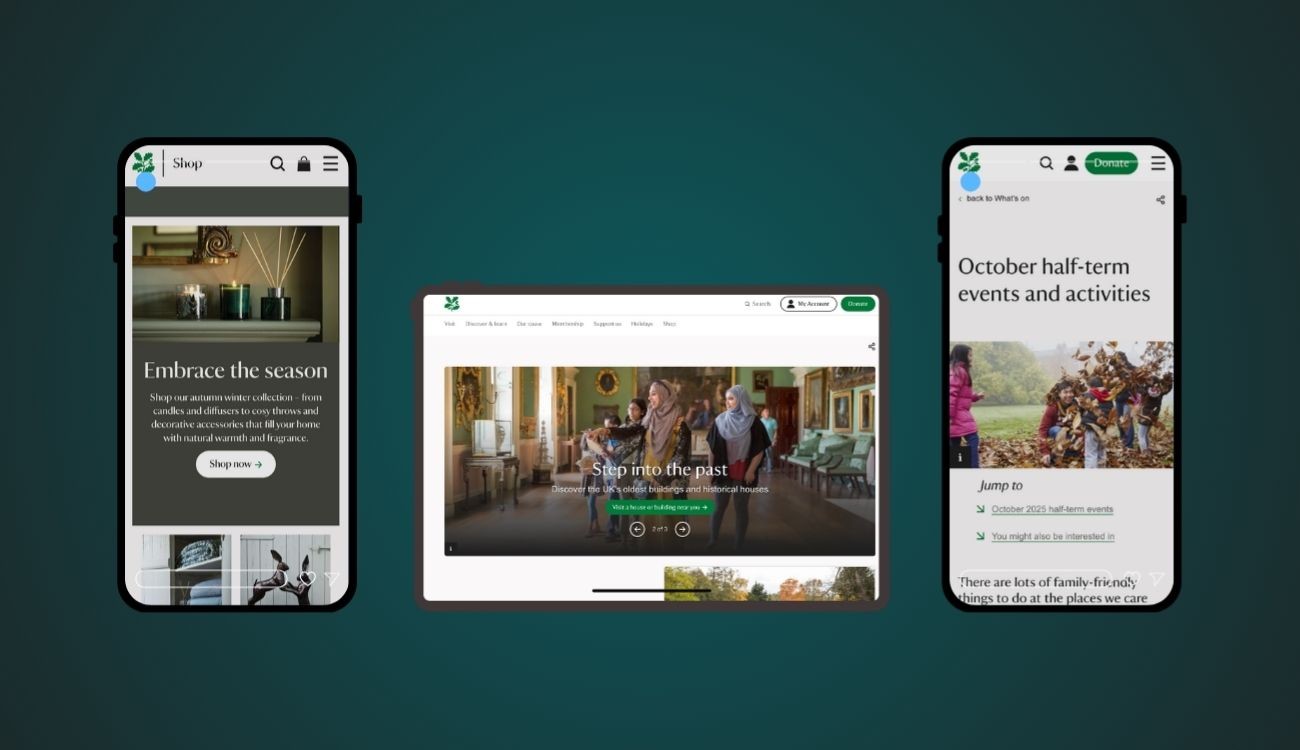
Digital & Designs architected a custom website development solution for the National Trust grounded in modularity, performance, content-commerce cohesion, and agility.
1. Modular Component Architecture & CMS Decoupling
Built the site on a modular component system (for media blocks, map widgets, callouts, event cards, story layouts) to allow flexible recomposition of pages without deep code changes.
Decoupled editorial content, property listings, and membership/donation flows via a headless or hybrid CMS architecture, enabling independent updates while maintaining unified UI/UX.
2. Performance & Load Optimization
Employed advanced image strategies (responsive images, lazy loading, progressive JPEG/WebP formats) for huge media assets across property galleries and heritage pages.
Utilized edge caching, smart CDN strategies, and partial hydration to balance interactivity with performance.
Optimized interactive maps (for property locations, trails) to load progressively, only rendering high-detail data when needed.
3. Content-Transaction Integration & UX Flows
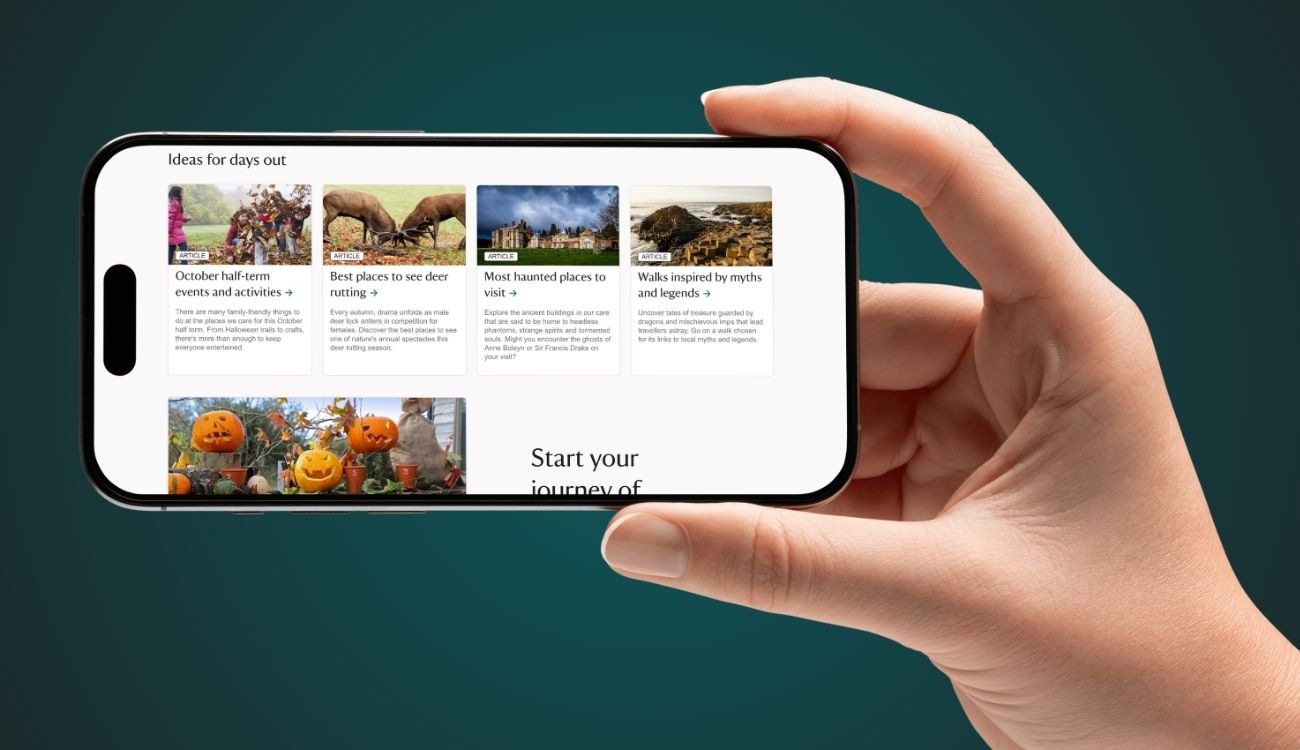
Streamlined transitions from editorial content (e.g. Discover & Learn pages) to visit/donation or membership flows, ensuring continuity in visual layout and messaging. (see Discover & Learn section) (National Trust)
Embedded contextual calls to action within storytelling — e.g. showing membership or donation prompts within heritage stories.
Created flexible templates to host campaign landing pages (e.g. seasonal themes, membership drives) that reuse core modules and styles.
4. Experimentation & Campaign Agility
Built feature-flag support and dynamic modules so the marketing team could activate (or retire) campaigns without full development cycles.
Provided interfaces for non-technical content editors to assemble landing experiences (hero blocks, feature links, donation modules) within guardrails of design consistency.
5. Personalization & Audience Segmentation
Incorporated user segmentation logic (visitor vs member vs donor) to dynamically adjust navigation, recommended content, and calls to action.
Enabled content modules personalized by region, interest (gardens, architecture, conservation), or recent site behavior.
Linked to membership APIs to show member-only content or rewards, and streamline renewal flows within the same site experience.
Concept
Here are the core architectural and design concepts applied in the National Trust custom development:
Concept | Application in the National Trust Project |
Modular & Reusable Component System | Pages built from a shared library of blocks (maps, galleries, callouts) to maintain consistency and flexibility. |
Hybrid / Headless CMS Architecture | Editorial and transactional functions separated yet unified in presentation, enabling independent updates. |
Performance-First Strategy | Lazy loading, responsive media, caching, and partial hydration to ensure fast and smooth experience across devices. |
Content-Transactional Continuum | Integrating discovery content with membership, donation, or visitation flows to reduce drop-off. |
Campaign Agility & Feature Flags | Allowing marketing teams to launch or retire campaign modules without developer intervention. |
Dynamic Personalization | Adapt UI and content based on user status and interests to deliver relevant and engaging experiences. |
More Works

FAQ
01
What budget should we start with?
02
Do you produce creatives?
03
Can you work with our influencer program?
03
How soon to results?

National Trust UK
National Trust (UK) — Custom Website Development Case Study
Custom Website Development
Problem
The National Trust, one of the UK’s most respected conservation and heritage organisations, operates a vast digital presence encompassing properties, gardens, historic houses, membership, donation flows, and editorial content. But their site faced several structural and technical challenges:
Legacy infrastructure and rigid architecture
Their platform was not sufficiently flexible or modular to support evolving campaigns, site features, and a large diversity of content types (places, events, stories, donations).
Performance & scalability constraints
The sheer scale of catalog pages (properties, estates, trails), high-resolution media, interactive maps, and membership/donation flows caused performance bottlenecks, particularly on mobile and low-bandwidth connections.Content / Commerce / Membership friction
The merging of editorial storytelling (e.g. Discover & Learn content), membership portals, event bookings, and donation mechanisms lacked seamless UX integration, causing user drop-off during transitions between content and transactional flows (e.g. “Discover a place” → “Become a member / visit”).Campaign agility & experimentation limitations
Running seasonal or promotional campaigns (e.g. “Explore autumn landscapes,” “heritage open days,” “donation drives”) required custom code support, slowing turnaround and limiting flexibility for the marketing team.Complex navigation & personalization challenges
Users exploring different needs (visitors, members, donors, educators) had to navigate through a one-size-fits-all structure, making it hard to deliver tailored experiences or personal recommendations.
These issues collectively hindered the National Trust from fully maximizing the digital experience for visitors, members, and donors — and limited their ability to evolve the platform responsively.
Solution
Digital & Designs architected a custom website development solution for the National Trust grounded in modularity, performance, content-commerce cohesion, and agility.
1. Modular Component Architecture & CMS Decoupling
Built the site on a modular component system (for media blocks, map widgets, callouts, event cards, story layouts) to allow flexible recomposition of pages without deep code changes.
Decoupled editorial content, property listings, and membership/donation flows via a headless or hybrid CMS architecture, enabling independent updates while maintaining unified UI/UX.
2. Performance & Load Optimization
Employed advanced image strategies (responsive images, lazy loading, progressive JPEG/WebP formats) for huge media assets across property galleries and heritage pages.
Utilized edge caching, smart CDN strategies, and partial hydration to balance interactivity with performance.
Optimized interactive maps (for property locations, trails) to load progressively, only rendering high-detail data when needed.
3. Content-Transaction Integration & UX Flows
Streamlined transitions from editorial content (e.g. Discover & Learn pages) to visit/donation or membership flows, ensuring continuity in visual layout and messaging. (see Discover & Learn section) (National Trust)
Embedded contextual calls to action within storytelling — e.g. showing membership or donation prompts within heritage stories.
Created flexible templates to host campaign landing pages (e.g. seasonal themes, membership drives) that reuse core modules and styles.
4. Experimentation & Campaign Agility
Built feature-flag support and dynamic modules so the marketing team could activate (or retire) campaigns without full development cycles.
Provided interfaces for non-technical content editors to assemble landing experiences (hero blocks, feature links, donation modules) within guardrails of design consistency.
5. Personalization & Audience Segmentation
Incorporated user segmentation logic (visitor vs member vs donor) to dynamically adjust navigation, recommended content, and calls to action.
Enabled content modules personalized by region, interest (gardens, architecture, conservation), or recent site behavior.
Linked to membership APIs to show member-only content or rewards, and streamline renewal flows within the same site experience.
Concept
Here are the core architectural and design concepts applied in the National Trust custom development:
Concept | Application in the National Trust Project |
Modular & Reusable Component System | Pages built from a shared library of blocks (maps, galleries, callouts) to maintain consistency and flexibility. |
Hybrid / Headless CMS Architecture | Editorial and transactional functions separated yet unified in presentation, enabling independent updates. |
Performance-First Strategy | Lazy loading, responsive media, caching, and partial hydration to ensure fast and smooth experience across devices. |
Content-Transactional Continuum | Integrating discovery content with membership, donation, or visitation flows to reduce drop-off. |
Campaign Agility & Feature Flags | Allowing marketing teams to launch or retire campaign modules without developer intervention. |
Dynamic Personalization | Adapt UI and content based on user status and interests to deliver relevant and engaging experiences. |
More Works
FAQ
01
What budget should we start with?
02
Do you produce creatives?
03
Can you work with our influencer program?
03
How soon to results?
National Trust UK
National Trust (UK) — Custom Website Development Case Study
Custom Website Development
Problem
The National Trust, one of the UK’s most respected conservation and heritage organisations, operates a vast digital presence encompassing properties, gardens, historic houses, membership, donation flows, and editorial content. But their site faced several structural and technical challenges:
Legacy infrastructure and rigid architecture
Their platform was not sufficiently flexible or modular to support evolving campaigns, site features, and a large diversity of content types (places, events, stories, donations).
Performance & scalability constraints
The sheer scale of catalog pages (properties, estates, trails), high-resolution media, interactive maps, and membership/donation flows caused performance bottlenecks, particularly on mobile and low-bandwidth connections.Content / Commerce / Membership friction
The merging of editorial storytelling (e.g. Discover & Learn content), membership portals, event bookings, and donation mechanisms lacked seamless UX integration, causing user drop-off during transitions between content and transactional flows (e.g. “Discover a place” → “Become a member / visit”).Campaign agility & experimentation limitations
Running seasonal or promotional campaigns (e.g. “Explore autumn landscapes,” “heritage open days,” “donation drives”) required custom code support, slowing turnaround and limiting flexibility for the marketing team.Complex navigation & personalization challenges
Users exploring different needs (visitors, members, donors, educators) had to navigate through a one-size-fits-all structure, making it hard to deliver tailored experiences or personal recommendations.
These issues collectively hindered the National Trust from fully maximizing the digital experience for visitors, members, and donors — and limited their ability to evolve the platform responsively.
Solution
Digital & Designs architected a custom website development solution for the National Trust grounded in modularity, performance, content-commerce cohesion, and agility.
1. Modular Component Architecture & CMS Decoupling
Built the site on a modular component system (for media blocks, map widgets, callouts, event cards, story layouts) to allow flexible recomposition of pages without deep code changes.
Decoupled editorial content, property listings, and membership/donation flows via a headless or hybrid CMS architecture, enabling independent updates while maintaining unified UI/UX.
2. Performance & Load Optimization
Employed advanced image strategies (responsive images, lazy loading, progressive JPEG/WebP formats) for huge media assets across property galleries and heritage pages.
Utilized edge caching, smart CDN strategies, and partial hydration to balance interactivity with performance.
Optimized interactive maps (for property locations, trails) to load progressively, only rendering high-detail data when needed.
3. Content-Transaction Integration & UX Flows
Streamlined transitions from editorial content (e.g. Discover & Learn pages) to visit/donation or membership flows, ensuring continuity in visual layout and messaging. (see Discover & Learn section) (National Trust)
Embedded contextual calls to action within storytelling — e.g. showing membership or donation prompts within heritage stories.
Created flexible templates to host campaign landing pages (e.g. seasonal themes, membership drives) that reuse core modules and styles.
4. Experimentation & Campaign Agility
Built feature-flag support and dynamic modules so the marketing team could activate (or retire) campaigns without full development cycles.
Provided interfaces for non-technical content editors to assemble landing experiences (hero blocks, feature links, donation modules) within guardrails of design consistency.
5. Personalization & Audience Segmentation
Incorporated user segmentation logic (visitor vs member vs donor) to dynamically adjust navigation, recommended content, and calls to action.
Enabled content modules personalized by region, interest (gardens, architecture, conservation), or recent site behavior.
Linked to membership APIs to show member-only content or rewards, and streamline renewal flows within the same site experience.
Concept
Here are the core architectural and design concepts applied in the National Trust custom development:
Concept | Application in the National Trust Project |
Modular & Reusable Component System | Pages built from a shared library of blocks (maps, galleries, callouts) to maintain consistency and flexibility. |
Hybrid / Headless CMS Architecture | Editorial and transactional functions separated yet unified in presentation, enabling independent updates. |
Performance-First Strategy | Lazy loading, responsive media, caching, and partial hydration to ensure fast and smooth experience across devices. |
Content-Transactional Continuum | Integrating discovery content with membership, donation, or visitation flows to reduce drop-off. |
Campaign Agility & Feature Flags | Allowing marketing teams to launch or retire campaign modules without developer intervention. |
Dynamic Personalization | Adapt UI and content based on user status and interests to deliver relevant and engaging experiences. |
More Works
FAQ
What budget should we start with?
Do you produce creatives?
Can you work with our influencer program?
How soon to results?