
Peloton
Custom features: dashboard, real-time class interface, membership portal, interactive content
Problem
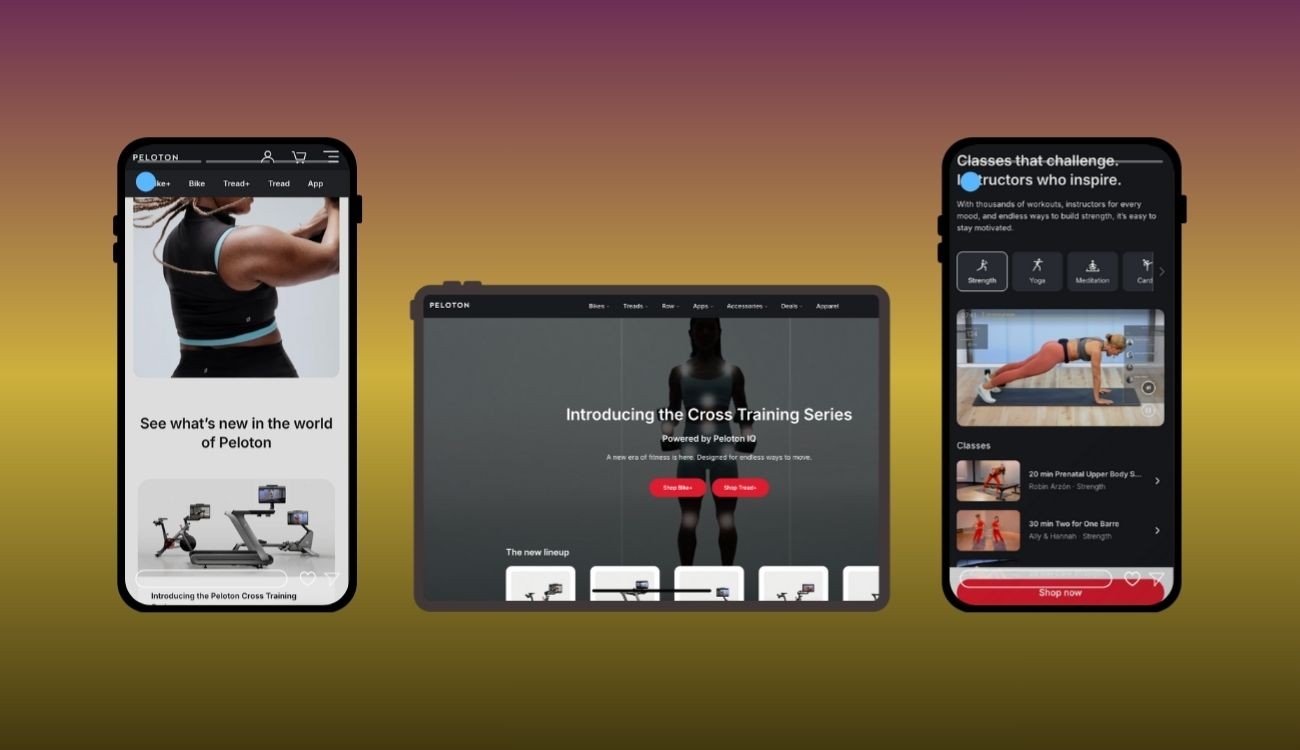
Peloton, a global leader in connected fitness, built a strong digital brand around interactive home workouts. However, with rapid product expansion (Bike+, Tread, Row, App), their web infrastructure began facing strategic and technical challenges that limited flexibility, scalability, and performance:
Fragmented product architecture
Each product—Peloton Bike+, Tread, and Row—operated on similar but siloed templates, making global updates complex and inconsistent.
Performance and page load inefficiencies
High-resolution visuals, embedded media, and interactive demos created latency across key conversion paths like product detail pages and checkout.Inflexible CMS for marketing teams
Launching new product stories, campaigns, or seasonal offers required heavy developer involvement, slowing down creative turnaround.Internationalization and localization challenges
Peloton’s global growth meant managing localized content, pricing, and compliance requirements across markets was increasingly difficult.Conversion funnel optimization
The checkout and lead funnel (from product exploration → purchase or app signup) lacked dynamic personalization and adaptive recommendations, leading to missed opportunities to upsell and convert.
These constraints made it difficult for Peloton’s teams to quickly iterate campaigns, ensure visual consistency, and maintain top-tier performance at scale.
Solution
Digital & Designs engineered a custom web development framework for Peloton designed for performance, modularity, and marketing agility.
1. Unified Modular Architecture
Built a modular front-end component system (cards, banners, media blocks, CTAs) allowing teams to reuse, reorder, or restyle content without custom code.
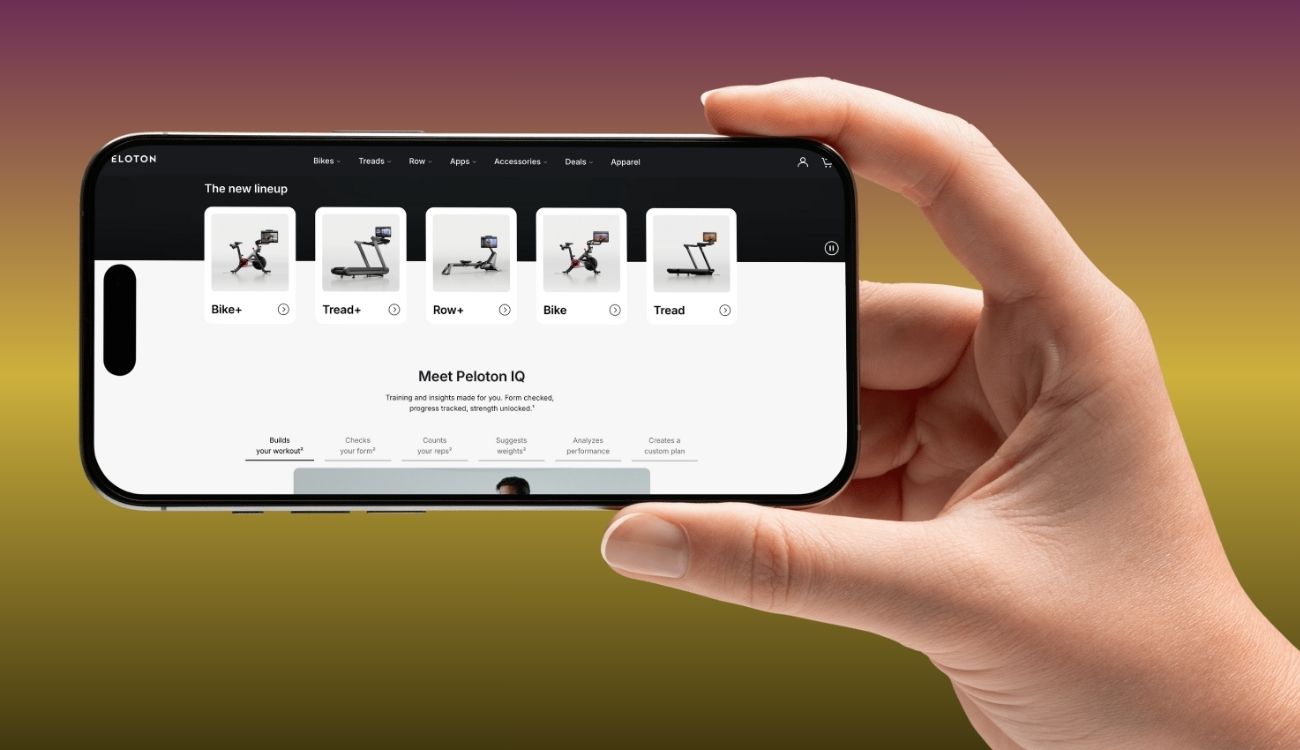
Standardized product pages for Bike+, Tread, and Row while retaining product-specific visual identities.
Centralized layout and design tokens for typography, grid, and interaction patterns across all site sections.
2. Custom Headless CMS Integration
Implemented a headless CMS architecture enabling marketing to publish or update campaign content instantly.
Supported localized content variations (language, currency, imagery) through dynamic data fields for global deployment.
Integrated with Peloton’s internal APIs for live product data, availability, and pricing.
3. Performance Optimization
Adopted server-side rendering (SSR) with edge caching to minimize time-to-first-byte (TTFB) and improve Core Web Vitals.
Optimized all media assets: adaptive image sizing, lazy loading, and pre-loading key LCP (Largest Contentful Paint) elements.
Reduced JavaScript bundle sizes through code splitting and dependency trimming.
4. Conversion-Driven UX Enhancements
Redesigned product detail and checkout flows with simplified UI, trust-building signals, and real-time finance calculator integrations.
Introduced contextual cross-sells (e.g., weights, accessories) directly within product pages.
Added adaptive CTA logic—personalized offers, “Start Free Trial” or “Learn More”—based on user behavior and region.
5. QA, Testing & Continuous Deployment
Built a continuous integration / delivery pipeline (CI/CD) for faster rollouts and instant reversions if needed.
Conducted multivariate testing on hero layouts, pricing presentation, and CTA placement to optimize engagement.
Integrated analytics tracking for scroll depth, add-to-cart events, and funnel drop-off monitoring.
Concepts
Here are the core architectural and design concepts applied in the Peloton custom development:
Concept | Application in Peloton Project |
Headless Architecture | Decoupled front-end from CMS for flexible content management and rapid marketing deployment. |
Component-Driven Development | Built modular, reusable design blocks ensuring scalability and consistency across all product lines. |
Performance-First Engineering | SSR, edge caching, and optimized media reduced page load times and improved Core Web Vitals. |
Internationalization (i18n) Framework | Dynamic content management for multiple locales, currencies, and compliance settings. |
Personalized Conversion UX | Contextual CTAs and adaptive checkout flows enhanced engagement and conversion. |
More Works
FAQ
01
What budget should we start with?
02
Do you produce creatives?
03
Can you work with our influencer program?
03
How soon to results?

Peloton
Custom features: dashboard, real-time class interface, membership portal, interactive content
Problem
Peloton, a global leader in connected fitness, built a strong digital brand around interactive home workouts. However, with rapid product expansion (Bike+, Tread, Row, App), their web infrastructure began facing strategic and technical challenges that limited flexibility, scalability, and performance:
Fragmented product architecture
Each product—Peloton Bike+, Tread, and Row—operated on similar but siloed templates, making global updates complex and inconsistent.
Performance and page load inefficiencies
High-resolution visuals, embedded media, and interactive demos created latency across key conversion paths like product detail pages and checkout.Inflexible CMS for marketing teams
Launching new product stories, campaigns, or seasonal offers required heavy developer involvement, slowing down creative turnaround.Internationalization and localization challenges
Peloton’s global growth meant managing localized content, pricing, and compliance requirements across markets was increasingly difficult.Conversion funnel optimization
The checkout and lead funnel (from product exploration → purchase or app signup) lacked dynamic personalization and adaptive recommendations, leading to missed opportunities to upsell and convert.
These constraints made it difficult for Peloton’s teams to quickly iterate campaigns, ensure visual consistency, and maintain top-tier performance at scale.
Solution
Digital & Designs engineered a custom web development framework for Peloton designed for performance, modularity, and marketing agility.
1. Unified Modular Architecture
Built a modular front-end component system (cards, banners, media blocks, CTAs) allowing teams to reuse, reorder, or restyle content without custom code.
Standardized product pages for Bike+, Tread, and Row while retaining product-specific visual identities.
Centralized layout and design tokens for typography, grid, and interaction patterns across all site sections.
2. Custom Headless CMS Integration
Implemented a headless CMS architecture enabling marketing to publish or update campaign content instantly.
Supported localized content variations (language, currency, imagery) through dynamic data fields for global deployment.
Integrated with Peloton’s internal APIs for live product data, availability, and pricing.
3. Performance Optimization
Adopted server-side rendering (SSR) with edge caching to minimize time-to-first-byte (TTFB) and improve Core Web Vitals.
Optimized all media assets: adaptive image sizing, lazy loading, and pre-loading key LCP (Largest Contentful Paint) elements.
Reduced JavaScript bundle sizes through code splitting and dependency trimming.
4. Conversion-Driven UX Enhancements
Redesigned product detail and checkout flows with simplified UI, trust-building signals, and real-time finance calculator integrations.
Introduced contextual cross-sells (e.g., weights, accessories) directly within product pages.
Added adaptive CTA logic—personalized offers, “Start Free Trial” or “Learn More”—based on user behavior and region.
5. QA, Testing & Continuous Deployment
Built a continuous integration / delivery pipeline (CI/CD) for faster rollouts and instant reversions if needed.
Conducted multivariate testing on hero layouts, pricing presentation, and CTA placement to optimize engagement.
Integrated analytics tracking for scroll depth, add-to-cart events, and funnel drop-off monitoring.
Concepts
Here are the core architectural and design concepts applied in the Peloton custom development:
Concept | Application in Peloton Project |
Headless Architecture | Decoupled front-end from CMS for flexible content management and rapid marketing deployment. |
Component-Driven Development | Built modular, reusable design blocks ensuring scalability and consistency across all product lines. |
Performance-First Engineering | SSR, edge caching, and optimized media reduced page load times and improved Core Web Vitals. |
Internationalization (i18n) Framework | Dynamic content management for multiple locales, currencies, and compliance settings. |
Personalized Conversion UX | Contextual CTAs and adaptive checkout flows enhanced engagement and conversion. |
More Works
FAQ
01
What budget should we start with?
02
Do you produce creatives?
03
Can you work with our influencer program?
03
How soon to results?
Peloton
Custom features: dashboard, real-time class interface, membership portal, interactive content
Problem
Peloton, a global leader in connected fitness, built a strong digital brand around interactive home workouts. However, with rapid product expansion (Bike+, Tread, Row, App), their web infrastructure began facing strategic and technical challenges that limited flexibility, scalability, and performance:
Fragmented product architecture
Each product—Peloton Bike+, Tread, and Row—operated on similar but siloed templates, making global updates complex and inconsistent.
Performance and page load inefficiencies
High-resolution visuals, embedded media, and interactive demos created latency across key conversion paths like product detail pages and checkout.Inflexible CMS for marketing teams
Launching new product stories, campaigns, or seasonal offers required heavy developer involvement, slowing down creative turnaround.Internationalization and localization challenges
Peloton’s global growth meant managing localized content, pricing, and compliance requirements across markets was increasingly difficult.Conversion funnel optimization
The checkout and lead funnel (from product exploration → purchase or app signup) lacked dynamic personalization and adaptive recommendations, leading to missed opportunities to upsell and convert.
These constraints made it difficult for Peloton’s teams to quickly iterate campaigns, ensure visual consistency, and maintain top-tier performance at scale.
Solution
Digital & Designs engineered a custom web development framework for Peloton designed for performance, modularity, and marketing agility.
1. Unified Modular Architecture
Built a modular front-end component system (cards, banners, media blocks, CTAs) allowing teams to reuse, reorder, or restyle content without custom code.
Standardized product pages for Bike+, Tread, and Row while retaining product-specific visual identities.
Centralized layout and design tokens for typography, grid, and interaction patterns across all site sections.
2. Custom Headless CMS Integration
Implemented a headless CMS architecture enabling marketing to publish or update campaign content instantly.
Supported localized content variations (language, currency, imagery) through dynamic data fields for global deployment.
Integrated with Peloton’s internal APIs for live product data, availability, and pricing.
3. Performance Optimization
Adopted server-side rendering (SSR) with edge caching to minimize time-to-first-byte (TTFB) and improve Core Web Vitals.
Optimized all media assets: adaptive image sizing, lazy loading, and pre-loading key LCP (Largest Contentful Paint) elements.
Reduced JavaScript bundle sizes through code splitting and dependency trimming.
4. Conversion-Driven UX Enhancements
Redesigned product detail and checkout flows with simplified UI, trust-building signals, and real-time finance calculator integrations.
Introduced contextual cross-sells (e.g., weights, accessories) directly within product pages.
Added adaptive CTA logic—personalized offers, “Start Free Trial” or “Learn More”—based on user behavior and region.
5. QA, Testing & Continuous Deployment
Built a continuous integration / delivery pipeline (CI/CD) for faster rollouts and instant reversions if needed.
Conducted multivariate testing on hero layouts, pricing presentation, and CTA placement to optimize engagement.
Integrated analytics tracking for scroll depth, add-to-cart events, and funnel drop-off monitoring.
Concepts
Here are the core architectural and design concepts applied in the Peloton custom development:
Concept | Application in Peloton Project |
Headless Architecture | Decoupled front-end from CMS for flexible content management and rapid marketing deployment. |
Component-Driven Development | Built modular, reusable design blocks ensuring scalability and consistency across all product lines. |
Performance-First Engineering | SSR, edge caching, and optimized media reduced page load times and improved Core Web Vitals. |
Internationalization (i18n) Framework | Dynamic content management for multiple locales, currencies, and compliance settings. |
Personalized Conversion UX | Contextual CTAs and adaptive checkout flows enhanced engagement and conversion. |
More Works
FAQ
What budget should we start with?
Do you produce creatives?
Can you work with our influencer program?
How soon to results?